…Hawkins How To Create A Mind - Ray Kurzweil The Language Instinct - Steven Pinker The Origin of Wealth - Eric Beinhocker The Signal and the Noise - Nate Silver The Money Culture - Michael Lewis Knowledge and the Wealth of Nations - David Warsh Smart Machines: IBM's Watson and the Era of Cognitive Computing - John E. Kelly III and Steve Hamm The Idea Factory - Jon Gertner Winning The Knowledge Transfer Race - Michael J. English…
…bubbles, users as if they're investors. See Davenport and Becks 'Attention Economy' as well as Mark Anielski's 'Economics of Happiness'. And to see the where I'm eventually trying to lead, see David Warsh's 'Knowledge and the Wealth of Nations' and the 2005 World Bank paper called "Where is the Wealth of Nations."
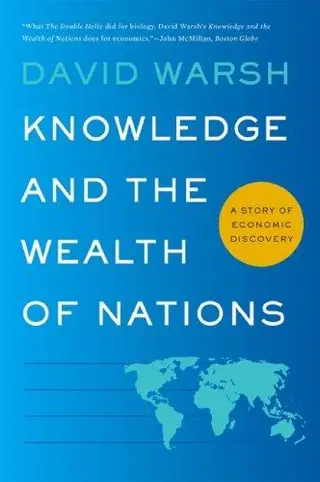
"Knowledge and the Wealth of Nations" by David Warsh (2007). It's really two books: It shows how the academic field of Economics works today, and covers much of the field's history; and it also examines Paul Romer's theory of economic growth,…
…misinformed. Macroeconomics relies very heavily on mathematical tools such as calculus and topology to model the collective behavior of humans. If you are really interested in learning more, I recommend "Knowledge and the Wealth of Nations: A Story of Economic Discovery".
…aware of it or not. And that lowering of transaction costs means that the world does become more efficient at allocating resources, if the Coase Theorem is true. Our professor read us a passage from Knowledge and the Wealth of Nations, part of which is cited here (edit: only a bit more detailed than the text in OP, but I still think it's a cool scene worth mentioning): http://www.salon.com/2006/11/16/milton_friedman/ That was the…
…both QWERTY-is-superior and QWERTY-demonstrates-market-failure stories are remarkably hardy perennials, presented as established fact without acknowledging the Liebowitz/Margolis counterargument. (E.g., _Knowledge and the Wealth of Nations_ by David Walsh (2006), carries approving blurbs from _The Financial Times_ and _The Economist_ on its cover, and should be easy to find in a library, maybe even a chain bookstore. "Paul David" and QWERTY…
……霍金斯;《如何创造心灵》——雷·库兹韦尔;《语言本能》——史蒂芬·平克;《财富的起源》——埃里克·拜因霍克;《信号与噪声》——奈特·西尔弗;《金钱文化》——迈克尔·刘易斯;《知识与国家财富》——大卫·沃什;《聪明的机器:IBM 沃森与认知计算时代》——约翰·E·凯利三世与史蒂夫·哈姆;《思想工厂》——乔恩·格特纳;《赢得知识转移竞赛》——迈克尔·J·英格利希……
…Hawkins How To Create A Mind - Ray Kurzweil The Language Instinct - Steven Pinker The Origin of Wealth - Eric Beinhocker The Signal and the Noise - Nate Silver The Money Culture - Michael Lewis Knowledge and the Wealth of Nations - David Warsh Smart Machines: IBM's Watson and the Era of Cognitive Computing - John E. Kelly III and Steve Hamm The Idea Factory - Jon Gertner Winning The Knowledge Transfer Race - Michael J. English…
……泡沫,把用户当成投资人来看待。可以参考达文波特和贝克的《注意力经济》,以及马克·安尼尔斯基的《幸福经济学》。要明白我最终想引向哪里,可以看看大卫·沃什的《知识与国家财富》以及世界银行 2005 年的报告《国家财富在何方》。
…bubbles, users as if they're investors. See Davenport and Becks 'Attention Economy' as well as Mark Anielski's 'Economics of Happiness'. And to see the where I'm eventually trying to lead, see David Warsh's 'Knowledge and the Wealth of Nations' and the 2005 World Bank paper called "Where is the Wealth of Nations."
大卫·沃什的《知识与国家财富》(2007 年)。这实际上是合二为一的一本书:它展现了当今经济学学术界的运作方式,涵盖了该领域的大部分历史;同时它还探讨了保罗·罗默的经济增长理论,……
"Knowledge and the Wealth of Nations" by David Warsh (2007). It's really two books: It shows how the academic field of Economics works today, and covers much of the field's history; and it also examines Paul Romer's theory of economic growth,…
……被误导了。宏观经济学极其依赖微积分和拓扑学等数学工具来对人类的集体行为进行建模。如果你真的有兴趣了解更多,我推荐《知识与国家财富:经济学发现的故事》。
…misinformed. Macroeconomics relies very heavily on mathematical tools such as calculus and topology to model the collective behavior of humans. If you are really interested in learning more, I recommend "Knowledge and the Wealth of Nations: A Story of Economic Discovery".
……不管是否意识到这一点。如果科斯定理成立,那么交易成本的降低就意味着世界在资源配置上确实变得更有效率了。我们的教授当年给我们念过一段《知识与国家财富》里的节选,其中一部分引用在这里(编辑:只比楼主的原文详细了一点点,但我依然觉得这是一个很酷的场景,值得一提):http://www.salon.com/2006/11/16/milton_friedman/ 那就是……
…aware of it or not. And that lowering of transaction costs means that the world does become more efficient at allocating resources, if the Coase Theorem is true. Our professor read us a passage from Knowledge and the Wealth of Nations, part of which is cited here (edit: only a bit more detailed than the text in OP, but I still think it's a cool scene worth mentioning): http://www.salon.com/2006/11/16/milton_friedman/ That was the…
……无论是“QWERTY键盘更优越”还是“QWERTY键盘证明了市场失灵”,这两种说法都成了经久不衰的烂梗,被当成既成事实到处宣传,却闭口不提利博维茨和马戈利斯的反驳论点。(例如大卫·沃什 2006 年写的《知识与国家财富》,封面印着《金融时报》和《经济学人》的赞誉推荐,在图书馆很容易就能找到,连锁书店可能也有。“保罗·戴维”和 QWERTY……
…both QWERTY-is-superior and QWERTY-demonstrates-market-failure stories are remarkably hardy perennials, presented as established fact without acknowledging the Liebowitz/Margolis counterargument. (E.g., _Knowledge and the Wealth of Nations_ by David Walsh (2006), carries approving blurbs from _The Financial Times_ and _The Economist_ on its cover, and should be easy to find in a library, maybe even a chain bookstore. "Paul David" and QWERTY…