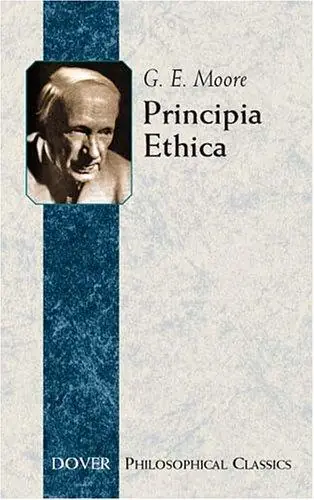
G.E. Moore didn't disappear from history. His Ethics (1907) and Principia Ethica (1903) both remain widely cited. His naturalistic fallacy remains a major tour de force in ethics[1], and his moral "super-objectivism" was studied and critiqued throughout the 1900s by every heavy hitter…
…deals with knowledge, reason, human reasoning, and empirical reason. One cannot ignore Kant or does so at his/her peril, (perhaps this book is better left until you've a fuller grasp of the subject). 17. Principia Ethica—G. E. Moore (George Edward) Prof of Phil., Cambridge, UK at turn of the 20th Century. Since it was published in 1903 Principia Ethica has had a huge influence on philosophers and still does (incl. yours…
…world where traditional ethics has gone off the rails, the study of ethics is absolutely essential. The key person to study here is the English philosopher G. E. Moore, and the definitive text is Moore's Principia ethica. 7e. Philosophy of Language. an ancient branch of philosophy which gained prominence in the last century under Wittgenstein. Basically it's concerned with how our languages affect our thought. Classic…
Having been brought up on G.E. Moore's Principia Ethica not to mention the work of Russell and Whitehead I'd have to say what I said as a first-pass comment. However I agree with you, things are never quite as simple as they seem when one grinds them fine,…
"G.E. Moore didn't disappear from history. His Ethics (1907) and Principia Ethica (1903) both remain widely cited." Correct, G.E. Moore certainly didn't disappear from history. I still have my copy of Principia Ethica that was drummed into me in Phil. classes at university decades…
Right, true. Hovever, the matter of goodness/ethics, etc. is probably best summed up by G.E. Moore in his 1903 work Principia Ethica: https://en.m.wikipedia.org/wiki/Principia_Ethica
G·E·摩尔并没有在历史中销声匿迹。他的《伦理学》(1907)和《伦理学原理》(1903)至今仍被广泛引用。他的自然主义谬误在伦理学界依然是一项重磅力作[1],而他的道德“超级客观主义”贯穿整个20世纪,受到每一位重量级学者的研究与批判……
G.E. Moore didn't disappear from history. His Ethics (1907) and Principia Ethica (1903) both remain widely cited. His naturalistic fallacy remains a major tour de force in ethics[1], and his moral "super-objectivism" was studied and critiqued throughout the 1900s by every heavy hitter…
……探讨了知识、理性、人类推理以及经验理性。谁也不能忽视康德,否则后果自负(或许这本书最好留到你对这个课题有更全面把握之后再读)。17. 《伦理学原理》——G·E·摩尔(乔治·爱德华),20世纪之交英国剑桥大学的哲学教授。自1903年出版以来,《伦理学原理》对哲学家们产生了巨大影响,至今依然如此(包括在下……
…deals with knowledge, reason, human reasoning, and empirical reason. One cannot ignore Kant or does so at his/her peril, (perhaps this book is better left until you've a fuller grasp of the subject). 17. Principia Ethica—G. E. Moore (George Edward) Prof of Phil., Cambridge, UK at turn of the 20th Century. Since it was published in 1903 Principia Ethica has had a huge influence on philosophers and still does (incl. yours…
……在一个传统伦理已经偏离轨道的世界上,伦理学研究是绝对不可或缺的。这里要研究的关键人物是英国哲学家 G·E·摩尔,而最具代表性的著作就是摩尔的《伦理学原理》。7e. 语言哲学。哲学的一个古老分支,上个世纪在维特根斯坦的推动下名声大噪。基本上它关心的就是语言如何影响我们的思维。经典的……
…world where traditional ethics has gone off the rails, the study of ethics is absolutely essential. The key person to study here is the English philosopher G. E. Moore, and the definitive text is Moore's Principia ethica. 7e. Philosophy of Language. an ancient branch of philosophy which gained prominence in the last century under Wittgenstein. Basically it's concerned with how our languages affect our thought. Classic…
从小读着 G·E·摩尔的《伦理学原理》长大,更不用说罗素和怀特海的著作了,我只能给出方才那样的初步评价。不过我同意你的看法,一旦把事情掰扯细了,就绝不会像表面看起来那么简单……
Having been brought up on G.E. Moore's Principia Ethica not to mention the work of Russell and Whitehead I'd have to say what I said as a first-pass comment. However I agree with you, things are never quite as simple as they seem when one grinds them fine,…
“G·E·摩尔并没有在历史中销声匿迹。他的《伦理学》(1907)和《伦理学原理》(1903)至今仍被广泛引用。”没错,G·E·摩尔绝对没有在历史中销声匿迹。几十年前在大学哲学课上被强行灌输的那本《伦理学原理》,我到现在还留着……
"G.E. Moore didn't disappear from history. His Ethics (1907) and Principia Ethica (1903) both remain widely cited." Correct, G.E. Moore certainly didn't disappear from history. I still have my copy of Principia Ethica that was drummed into me in Phil. classes at university decades…
对,确实。不过,关于善/伦理等问题的讨论,大概在 G·E·摩尔 1903 年的著作《伦理学原理》中得到了最好的概括:https://en.m.wikipedia.org/wiki/Principia_Ethica
Right, true. Hovever, the matter of goodness/ethics, etc. is probably best summed up by G.E. Moore in his 1903 work Principia Ethica: https://en.m.wikipedia.org/wiki/Principia_Ethica