……关于 https://en.wikipedia.org/wiki/Paradoxes_of_material_implicat... :只要跳出数学命题的世界,~(A & ~B) 对“如果 A 则 B”来说就是一个非常蹩脚的近似。Graham Priest 的《非经典逻辑导论》(Introduction to Non-Classical Logic)http://www.cambridge.org/ie/academic/subjects/philosophy/phi... 写得极好(他在这个主题上的授课也很棒:Priest 真的应该去开门 MOOC……)
…the https://en.wikipedia.org/wiki/Paradoxes_of_material_implicat... : ~(A & ~B) is a very poor approximation of 'if A then B' once you leave the world of statements about mathematics. Graham Priest's /Introduction to Non-Classical Logic/ http://www.cambridge.org/ie/academic/subjects/philosophy/phi... is great (as is his lecturing on the subject: Priest really ought to do a MOOC...)
如果这引起了你的兴趣,赶紧去买一本 Graham Priest 的《非经典逻辑导论》(Introduction to Non-Classical Logic)。https://www.cambridge.org/ie/academic/subjects/philosophy/ph... 太精彩了。唯一遗憾的是网上似乎根本找不到 Graham Priest 现场授课的视频。
If this caught your interest, run out and buy Graham Priest's Introduction to Non-Classical Logic. https://www.cambridge.org/ie/academic/subjects/philosophy/ph... It's so good. It's just a pity that there doesn't seem to be video of Graham Priest teaching this material in person anywhere.
Graham Priest 的《非经典逻辑导论》(Introduction to Non-Classical Logic)https://www.cambridge.org/core/books/an-introduction-to-nonc... 实在是神作,完全配得上拥有 SICP 那种级别的死忠粉。不过它肯定会用证明、形式化这套语言来跟你对话。
Graham Priest's Introduction to Non-Classical Logic https://www.cambridge.org/core/books/an-introduction-to-nonc... is so good and deserves to have a SICP-like fandom. But it's certainly going to talk to you in terms of proof, formality and so on.
……用来解释非经典逻辑的非形式化元语言其实是传统的阶逻辑,例如参见 [1]。我不知道“辩证逻辑”(dialectical logic)是个什么逻辑。[1] Graham Priest,《非经典逻辑导论》(An Introduction to Non-Classical Logic)
…that the informal meta-language in which the non-classical logics are explained in is traditional first-order logic, see e.g. [1]. I don't know what "dialectical logic" logic is. [1] Graham Priest, An Introduction to Non-Classical Logic
……令人费解。确实,而且是有原因的:实质蕴涵(即文中讨论的那种蕴涵)并不能总是解释我们直觉上的蕴涵感。我最喜欢的例子来自 Priest 的《非经典逻辑导论》:当 ⇒ 是实质蕴涵时,(A ⇒ B) ∧ (C ⇒ D) ⊦ (A ⇒ D) ∨ (C ⇒ B) 是成立的,但如果换成命题:“如果约翰在巴黎,那他就在法国;如果约翰在伦敦,那他就在英格兰。因此,要么……”,这说法就立不住了。
…puzzling. Yes, and for a reason: material implication (the kind of implication discussed in the article) cannot always explain our intuitive sense of implication. My favourite example, from Priest's Introduction to Non-Classical Logic: (A ⇒ B) ∧ (C ⇒ D) ⊦ (A ⇒ D) ∨ (C ⇒ B) is valid when ⇒ is material, yet the statement: "If John is in Paris he is in France, and if John is in London he is in England. Hence, it is the case either that…
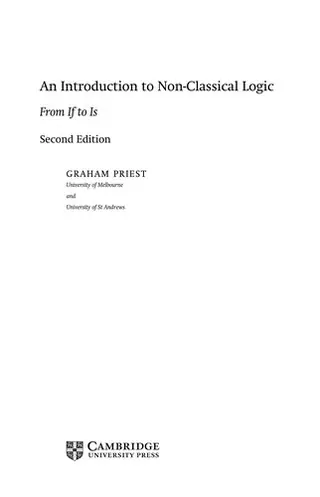
……关于 https://en.wikipedia.org/wiki/Paradoxes_of_material_implicat... :只要跳出数学命题的世界,~(A & ~B) 对“如果 A 则 B”来说就是一个非常蹩脚的近似。Graham Priest 的《非经典逻辑导论》(Introduction to Non-Classical Logic)http://www.cambridge.org/ie/academic/subjects/philosophy/phi... 写得极好(他在这个主题上的授课也很棒:Priest 真的应该去开门 MOOC……)
…the https://en.wikipedia.org/wiki/Paradoxes_of_material_implicat... : ~(A & ~B) is a very poor approximation of 'if A then B' once you leave the world of statements about mathematics. Graham Priest's /Introduction to Non-Classical Logic/ http://www.cambridge.org/ie/academic/subjects/philosophy/phi... is great (as is his lecturing on the subject: Priest really ought to do a MOOC...)
如果这引起了你的兴趣,赶紧去买一本 Graham Priest 的《非经典逻辑导论》(Introduction to Non-Classical Logic)。https://www.cambridge.org/ie/academic/subjects/philosophy/ph... 太精彩了。唯一遗憾的是网上似乎根本找不到 Graham Priest 现场授课的视频。
If this caught your interest, run out and buy Graham Priest's Introduction to Non-Classical Logic. https://www.cambridge.org/ie/academic/subjects/philosophy/ph... It's so good. It's just a pity that there doesn't seem to be video of Graham Priest teaching this material in person anywhere.
Graham Priest 的《非经典逻辑导论》(Introduction to Non-Classical Logic)https://www.cambridge.org/core/books/an-introduction-to-nonc... 实在是神作,完全配得上拥有 SICP 那种级别的死忠粉。不过它肯定会用证明、形式化这套语言来跟你对话。
Graham Priest's Introduction to Non-Classical Logic https://www.cambridge.org/core/books/an-introduction-to-nonc... is so good and deserves to have a SICP-like fandom. But it's certainly going to talk to you in terms of proof, formality and so on.
我自己并不是专家,但推荐这本:Graham Priest 写的《非经典逻辑导论》(An Introduction to Non-Classical Logic)。https://www.cambridge.org/core/books/an-introduction-to-nonc...
I'm no expert myself, but: An Introduction to Non-Classical Logic by Graham Priest. https://www.cambridge.org/core/books/an-introduction-to-nonc...
……用来解释非经典逻辑的非形式化元语言其实是传统的阶逻辑,例如参见 [1]。我不知道“辩证逻辑”(dialectical logic)是个什么逻辑。[1] Graham Priest,《非经典逻辑导论》(An Introduction to Non-Classical Logic)
…that the informal meta-language in which the non-classical logics are explained in is traditional first-order logic, see e.g. [1]. I don't know what "dialectical logic" logic is. [1] Graham Priest, An Introduction to Non-Classical Logic
……令人费解。确实,而且是有原因的:实质蕴涵(即文中讨论的那种蕴涵)并不能总是解释我们直觉上的蕴涵感。我最喜欢的例子来自 Priest 的《非经典逻辑导论》:当 ⇒ 是实质蕴涵时,(A ⇒ B) ∧ (C ⇒ D) ⊦ (A ⇒ D) ∨ (C ⇒ B) 是成立的,但如果换成命题:“如果约翰在巴黎,那他就在法国;如果约翰在伦敦,那他就在英格兰。因此,要么……”,这说法就立不住了。
…puzzling. Yes, and for a reason: material implication (the kind of implication discussed in the article) cannot always explain our intuitive sense of implication. My favourite example, from Priest's Introduction to Non-Classical Logic: (A ⇒ B) ∧ (C ⇒ D) ⊦ (A ⇒ D) ∨ (C ⇒ B) is valid when ⇒ is material, yet the statement: "If John is in Paris he is in France, and if John is in London he is in England. Hence, it is the case either that…