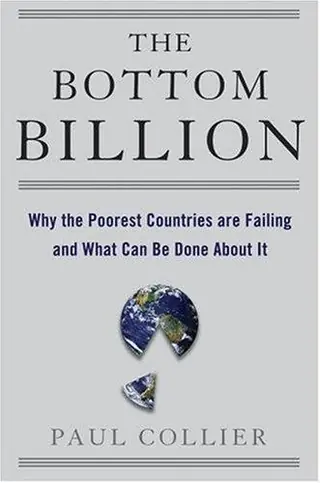
最底层的十亿人
The bottom billion
Paul Collier · 初版 2007 年
4人推荐
6位读者提及
6次提及
在这部出自全球顶尖非洲与贫困问题专家之一的优雅而充满激情的综合著作中,经济学家 Paul Collier 极具说服力地指出:尽管全球有近50亿人口正开始走出极度贫困,并受益于全球化向发展中国家的辐射,但世界底层仍有“bottom billion”(最底层的十亿人),他们所在的国家在很大程度上对全球经济力量免疫,正在进一步落后并面临分崩离析的危险,从而同世界其他地区发生永久而悲剧性的脱节。Collier 指出并阐释了这四种……
Hacker News 上怎么说
正在加载完整评论……
……向各个发展中国家提供了大约 1 到 2 万亿美元(注意是万亿)的资金。但这并没起多大作用。为什么会这样?有一大堆书都试图回答这个问题(对于好奇的人,我推荐《Dead Aid》《The Bottom Billion》以及《Why Nations Fail》)。我不觉得我们能得到一个完美的答案,但我们至少应该问对问题。(相关的背景是:我是个非营利组织的 grant writing 顾问……
…neighborhood of $1 – $2 trillion (with a "t") dollars to various developing countries. It hasn't done much. Why not? That's a question that a host of books have attempted to answer (I recommend Dead Aid, The Bottom Billion, and Why Nations Fail to the curious). I don't think we'll ever get a complete answer but we should at least be asking the right questions. (Relevant observation: I'm a grant writing consultant for nonprofit…
别光读 Moyo 的书。去读读阿比吉特·班纳吉(Abhijit Banerjee)和埃斯特·迪弗洛(Esther Duflo)写的《Poor Economics》。Duflo 任职于 MIT,一门心思搞随机对照试验来探究什么样的援助才管用。去读读牛津大学发展经济学家保罗·科利尔(Paul Collier)写的《The Bottom Billion》。去读读 Nina Munk 的《The Idealist》,它讲的是为什么我们可以说杰弗里·萨克斯(Geoffrey Sachs)的“千禧村项目”彻底失败了。再去读读《Africa Rising》……
Don't just read Moyo. Read 'Poor Economics' by Abhijit Banerjee and Esther Duflo. Duflo is at MIT and is all about trials to figure out what works with aid. Read 'The Bottom Billion' by Paul Collier who is a development economist at Oxford. Read 'The Idealist' by Nina Munk which is about how we can say that Geoffrey Sach's millennium village project has failed. Read 'Africa Rising'…
我很惊讶这里竟然有这么强烈的反世行情绪。你应该去读读《The Bottom Billion》,作者曾任世界银行发展研究组主任(2003-2008)http://en.wikipedia.org/wiki/The_Bottom_Billion
I'm surprised by the anti-world bank sentiment here. You should read 'The Bottom Billion', which was written by the director of the Development Research Group at the World bank (2003-2008) http://en.wikipedia.org/wiki/The_Bottom_Billion
《The Bottom Billion》是一本好书,探讨了导致世界上最贫困地区形成的各种因素,而撒哈拉以南非洲是其中最大的一个板块。https://en.wikipedia.org/wiki/The_Bottom_Billion
The Bottom Billion is a good book about the factors that make the poorest regions in the world, of which Sub-Saharan Africa is the largest block. https://en.wikipedia.org/wiki/The_Bottom_Billion
一家企业在亏钱,并不意味着它毫无价值。《Bottom Billion》的作者保罗·科利尔说过,贫穷国家之所以在资源上被严重剥削,是因为他们没有拿出来公开竞标。他甚至提到,英国政府曾经对某些频段估值 20 亿,但后来却卖出了 200 亿……
Just because a business is losing money, doesn't mean it has zero value. Paul Collier, author of the "Bottom Billion", said poor countries get screwed for their resources because they don't put them up to bid. He even said the British government valued certain frequencies at 2 billion, but they later sold for 20 billion…
……现在充斥着内部腐败,说白了就是各个小山头在争夺利益,而整个行业却经营不善。让我找找讲这个的那本经济学书……《The Bottom Billion》:https://en.wikipedia.org/wiki/The_Bottom_Billion 第 3 章讲的就是“自然资源陷阱”。我已经十多年没读过了,这种类比可能站不住脚,特别是在涉及到某些东西的时候……
…now is full of internal corruption which is just the petty fiefdoms all squabbling over the spoils, while the industry is being badly managed. Lets see if I can find the economics book on that... The Bottom Billion: https://en.wikipedia.org/wiki/The_Bottom_Billion Chapter 3 is on "the natural resources trap" I haven't read it in over a decade and the analogy may fall apart, particularly when it comes to stuff…