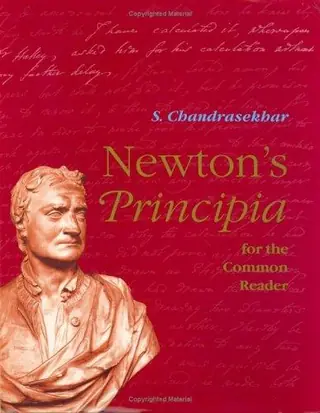
面向普通读者的牛顿原理
Newton's Principia for the common reader
Subrahmanyan Chandrasekhar · 初版 1995 年
2人推荐
3位读者提及
7次提及
“这部凝聚了一位杰出物理学家十年心血的著作,是首部不依赖二手文献对牛顿《Principia》进行全面分析的专著。钱德拉塞卡(Chandrasekhar)教授分析了约 150 个命题,这些命题构成了引向牛顿万有引力定律构想的直接链条。在每个案例中,牛顿的证明都被整理成线性的方程式与论证序列,读者无需再去费力梳理牛顿连贯散文中那些必然复杂的行文风格。在几乎每一个案例中,作者都给出了现代形式的证明,从而清晰突出其优美、明晰……
Hacker News 上怎么说
正在加载完整评论……
……给学生讲解核心思想。那么 HN 上的各位有什么属于这个类别的书推荐吗?我藏书里的几个例子:1) David Eugene Smith 的《A Source Book in Mathematics》;2) S. Chandrasekhar 的《Newton's Principia for the Common Reader》;3) Charles Petzold 的《The Annotated Turing: A Guided Tour Through Alan Turing's Historic Paper On Computability And The Turing Machine》;4) 《Maxwell on the Electromagnetic Field:……
…explain the main ideas to the Student. So what Books can HN folks recommend that fall into this category? A few examples from my collection; 1) A Source Book in Mathematics by David Eugene Smith. 2) Newton's Principia for the Common Reader by S. Chandrasekhar. 3) The Annotated Turing: A Guided Tour Through Alan Turing's Historic Paper On Computability And The Turing Machine by Charles Petzold. 4) Maxwell on the Electromagnetic Field:…
对研究《Principia》(自然哲学的数学原理)感兴趣的人可能会觉得这本书有用:诺奖得主、天体物理学家 S. Chandrashekhar 写的《Newton's Principia for the Common Reader》
People interested in studying the Principia might find the following useful: Newton's Principia for the Common Reader by S. Chandrashekhar (nobel prize winning astrophysicist)
……:Nicholas Nassim Taleb 的《The Black Swan》、Leonard Mlodinow 的《The Drunkards Walk》。数学/科学史:Leonard Mlodinow 的《Euclid's Window》、Bill Bryson 的《A Short History of Nearly Everything》。物理:S. Chandrasekhar 的《Newton's Principia for the Common Reader》。文学:Fyodor Dostoevsky 的《The Brothers Karamazov》、Mark Z. Danielewski 的《House of Leaves》、John Steinbeck 的《East of Eden》。哲学:Shunryu Suzuki 的《Zen Mind, Beginner's Mind》。任何……
…: The Black Swan by Nicholas Nassim Taleb The Drunkards Walk by Leonard Mlodinow Math/science history : Euclid's Window by Leonard Mlodinow A Short History of Nearly Everything by Bill Bryson Physics: Newton's Principia for the Common Reader by S. Chandrasekhar Lit: The Brothers Karamazov by Fyodor Dostoevsky House of Leaves by Mark Z. Danielewski East of Eden by John Steinbeck Philosophy: Zen Mind, Beginner's Mind by Shunryu Suzuki Any…
……解释,这样我也能从中学习。有几本挺有意思的:1) David Eugene Smith 的《A Source Book in Mathematics》(Dover 出版社)- https://archive.org/details/sourcebookinmath00smit 2) 诺奖得主物理学家 S. Chandrasekhar 的《Newton's Principia for the Common Reader》- https://archive.org/details/newtonsprincipia0000chan 3) Thomas……的《Maxwell on the Electromagnetic Field: A Guided Study》(Masterworks of Discovery 系列)
…explanations so that i can learn from them. Some interesting ones are; 1) A Source Book in Mathematics by David Eugene Smith (Dover Publications) - https://archive.org/details/sourcebookinmath00smit 2) Newton's Principia for the Common Reader by Nobel-prize winning Physicist S.Chandrasekhar - https://archive.org/details/newtonsprincipia0000chan 3) Maxwell on the Electromagnetic Field: A Guided Study (Masterworks of Discovery series) by Thomas…
……带你通读原始论文/专著。如果你缺乏必要的背景知识,理解起来依然很难,但起码你有了个不错的切入点。我书架上的几本:1) S. Chandrasekhar 的《Newton's Principia for the Common Reader》 2) Thomas Simpson 的《Maxwell on the Electromagnetic Field: A Guided Study》(Masterworks of Discovery 系列) 3) John Stachel 的《Einstein's Miraculous Year》 4) Charles……的《The Annotated Turing》
…guides you through the original paper/book. It is still difficult to understand if you do not have the necessary background but at least you have a good starting point. Some books in my collection; 1) Newton's Principia for the Common Reader by S.Chandrasekhar 2) Maxwell on the Electromagnetic Field: A Guided Study (Masterworks of Discovery) by Thomas Simpson 3) Einstein's Miraculous Year by John Stachel. 4) The Annotated Turing by Charles…
……去读/研究它。抛开晦涩古旧的语言和记号不谈,真正的概念性数学/科学本身就极其硬核。举个好例子:诺奖得主物理学家 S. Chandrasekhar 写了《Newton's Principia for the Common Reader》,在书里用现代符号和语言解释了《原理》的一部分(只涉及引力部分)。连他自己都觉得极难,所以书名里的“普通读者”(common reader)指的其实是……
…reading/studying it. Actual conceptual mathematics/science is intrinsically hard even ignoring the archaic language/notations. As a good example; the Nobel-prize winning physicist S.Chandrasekhar wrote Newton's Principia for the Common Reader where he explains a subset of the principia (only dealing with gravitation) using modern notation and language. He himself found it quite hard and thus the "common reader" in the title is somebody who…