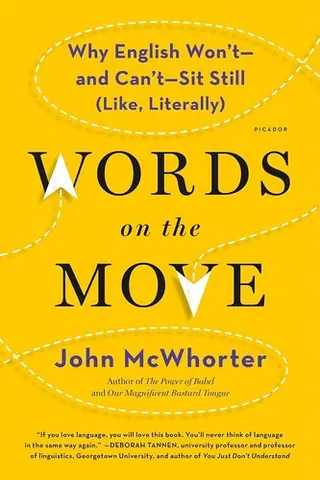
流动的词语
Words on the Move
John McWhorter · 初版 2016 年
5人推荐
8位读者提及
9次提及
“一位畅销语言学家带领我们生动地领略英语如何在眼前演变,以及我们为何应当接纳这种转变而不是抗拒它。语言总在变化——但我们往往并不喜欢这样。我们理解新事物需要造新词,但今天英语的口语表达方式却让许多人感到不快。无论将 literally 用作‘比喻地’而非‘字面地’,还是年轻人使用的 LOL 和 like,亦或是诸如 Whats the ask? 之类的商业行话,往往让人觉得语言正在我们眼前退化。但事……”
Hacker News 上怎么说
正在加载完整评论……
如果你喜欢这篇文章,你可能会喜欢 Russ Roberts 对 John McWhorter 的访谈 [0],他们在里面探讨了语言的演变以及 John 的新书《Words on the Move》。去听听看吧……大概 1 个小时(网页上有文字记录,阅读可能更快,但我更喜欢听他说话的个人魅力和热情)。[0] http://www.econtalk.org/archives/2017/08/john_mcwhorter.html
If you enjoy this article you may enjoy Russ Roberts interview of John McWhorter [0] where they discuss the evolution of language and Johns book "Words on the move" . give it a listen... approx 1 hour (the transcript is there which is also probably faster but I enjoyed the charisma and enthusiasm.) [0] http://www.econtalk.org/archives/2017/08/john_mcwhorter.html
LOL 的这种演变,在 John McWhorter 那本非常有趣又好读的书《Words on the Move: Why English Won't – and Can't – Sit Still (Like, Literally)》中被当作一个典型案例引用。https://bookshop.org/p/books/words-on-the-move-why-english-w...
This morphing of LOL is used as an example in the very interesting and enjoyable book "Words on the Move: Why English Won't – and Can't – Sit Still (Like, Literally)" by John McWhorter. https://bookshop.org/p/books/words-on-the-move-why-english-w...
……某个自作聪明的人写在书里的东西。没错,这直接踩中我的雷点了。(: Geoff Lindsey 博士是个很好的参考来源。另一个是 John McWhorter,尤其是他的《The Power of Babel》和《Words on the Move》这两本书。语言学家是研究自然世界的科学家,而不是制定法则的立法者。
…someone who thought they were clever wrote in a book. Yeah, this is a trigger for me. (: Dr. Geoff Lindsey is a great reference. Another is John McWhorter, specifically his books The Power of Babel and Words on the Move. Linguists are scientists of the natural world, not law-makers.
……推向主流的叙事,或者说 McWhorter 所称的“第三波反种族主义”。同样,作为一个“古典自由主义者”,我认为他们的观点值得探讨。--- 顺便提一句,我手头有本 McWhorter 写的《Words on the Move》,强烈推荐 :)
…narratives to the mainstream, or what McWhorter has called "third wave antiracism." Again, as a "classical liberal," I find their ideas worth considering. --- A side note, I have a copy of McWhorter's book "Words on the Move," and I highly recommend it :)
……在 John McWhorter 的语言学播客《Lexicon Valley》的一期节目中,讲的就是事实并非如此。http://www.slate.com/articles/podcasts/lexicon_valley.html 他专门写了一整本书来论述这个主题:《Words on the Move: Why English Won't - and Can't - Sit Still (Like, Literally)》。去看看吧。语言不仅会随着时间不断演化和改变(而且这根本不是语言正在滑向某种臆想出来的含混不清的……)
…episode of Lexicon Valley, John McWhorter's linguistics podcast, is about how that's not what's happening. http://www.slate.com/articles/podcasts/lexicon_valley.html He has a whole book about it: _ Words on the Move: Why English Won't - and Can't - Sit Still (Like, Literally)_. Check it out. Not only do languages evolve and change over time (and that's not a symptom of everything moving towards some imagined mushy…
“我最讨厌词义发生漂移了”——John McWhorter 将这种情况视为语言发展的必然规律。(事实上,他写过一本书,书名/副标题就是《Words on the Move: Why English Won't - and Can't - Sit Still (Like, Literally)》)。他探讨了这种现象的各种例子,无论是在政治语境还是非政治语境中。他的建议是欣然接受,并且……
"I hate when words drift in meaning" John McWhorter discusses this as an inevitability with language. (Indeed, he wrote a book with title / subtitle "Words on the Move: Why English Won't - and Can't - Sit Still (Like, Literally)"). He discusses various examples of this happening, both in political and non-political contexts. His suggestion is to just accept it, and…