…that to the whole universe. I have been much more convinced that the universe, starting from a maximally structured configuration, tends to even greater structure, as Julian Barbour wrote about in the Janus Point. Structure emergence, as opposed to catastrophic mixing. My perspective used to be like yours but it has become: the game is only starting.
…summarize it quite tersely) takes the idea of 3- or n-body simulations and goes very far indeed with it (i.e. why there is something rather than nothing), I highly recommend checking out Julian Barbour's The Janus Point.
…rotations, where you can sub `t -> it'`, and then Minkowskian spacetime becomes Euclidean but time becomes complex-valued. Groovy stuff. I'm not much of a physics buff but I loved reading Julian Barbour's The Janus Point for a great treatment of the possibility of negative time. The craziest thing I've seen though is the suggestion that an accelerating charge, emitting radiation that interacts with the charge itself…
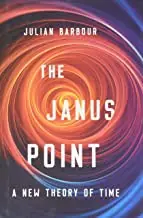
Barbour’s thesis is that the Big Bang, which he calls the Janus Point, seeded the flow of time in two directions. Time “no longer has one direction, from past to future, but instead has two: from a common past at the Janus point to two futures in the two directions away…
This idea has been explored by Julian Barbour in his book The Janus Point. http://www.platonia.com/books.html The related math and modelling goes under the name Shape Dynamics: https://en.wikipedia.org/wiki/Shape_dynamics Shape Dynamics - An Introduction https://arxiv.org/abs/1105.0183
I was literally thinking of the same similarities. Barbour's exposition of the principle of least action as being time is interesting. There's a section in The Janus Point where he goes into detail about the fact that there are parts of the cosmos that (due to cosmic inflation) are farther apart in terms of light-years than the universe is old, and growing in separation…
……把这一点推及到整个宇宙。我越来越相信,宇宙从一个极度结构化的构型出发,反而会趋向于更加复杂的结构,正如朱利安·巴伯(Julian Barbour)在《雅努斯点》(The Janus Point)中所写的那样。是结构涌现,而非灾难性的彻底混合。我以前的看法和你差不多,但现在变成了:这场好戏才刚刚开场。
…that to the whole universe. I have been much more convinced that the universe, starting from a maximally structured configuration, tends to even greater structure, as Julian Barbour wrote about in the Janus Point. Structure emergence, as opposed to catastrophic mixing. My perspective used to be like yours but it has become: the game is only starting.
……简单粗暴地概括一下)借用了3体或多体模拟的思路并大做文章(即探讨为什么是存在万物而非虚无),我强烈建议去读读朱利安·巴伯的《雅努斯点》。
…summarize it quite tersely) takes the idea of 3- or n-body simulations and goes very far indeed with it (i.e. why there is something rather than nothing), I highly recommend checking out Julian Barbour's The Janus Point.
……旋转,你可以做代换 `t -> it'`,这样闵可夫斯基时空就变成了欧几里得时空,但时间却变成了复数值。挺神妙的东西。我算不上什么物理发烧友,但我很喜欢读朱利安·巴伯的《雅努斯点》,里面对“负时间”可能性的阐述非常棒。不过我见过最狂野的想法,是说加速电荷辐射出的能量反过来又会与电荷自身相互作用……
…rotations, where you can sub `t -> it'`, and then Minkowskian spacetime becomes Euclidean but time becomes complex-valued. Groovy stuff. I'm not much of a physics buff but I loved reading Julian Barbour's The Janus Point for a great treatment of the possibility of negative time. The craziest thing I've seen though is the suggestion that an accelerating charge, emitting radiation that interacts with the charge itself…
巴伯的核心论点是:被称为“雅努斯点”的宇宙大爆炸,播下了时间向两个方向流动的种子。时间“不再只有从过去到未来的单一方向,而是变成了两个:从雅努斯点的共同过去出发,分别朝相反的两个方向流向两个不同的未来……
Barbour’s thesis is that the Big Bang, which he calls the Janus Point, seeded the flow of time in two directions. Time “no longer has one direction, from past to future, but instead has two: from a common past at the Janus point to two futures in the two directions away…
朱利安·巴伯在他的著作《雅努斯点》中探讨了这个想法。http://www.platonia.com/books.html 相关的数学和建模被称为“形状动力学”(Shape Dynamics):https://en.wikipedia.org/wiki/Shape_dynamics 《形状动力学导论》https://arxiv.org/abs/1105.0183
This idea has been explored by Julian Barbour in his book The Janus Point. http://www.platonia.com/books.html The related math and modelling goes under the name Shape Dynamics: https://en.wikipedia.org/wiki/Shape_dynamics Shape Dynamics - An Introduction https://arxiv.org/abs/1105.0183
我也正好在想同样的相似之处。巴伯把最小作用量原理阐释为时间,这一点很有意思。《雅努斯点》里有一节详细讲到了:宇宙中有些区域(由于宇宙暴胀)彼此之间的光年距离已经超过了宇宙本身的年龄,而且相距越来越远……
I was literally thinking of the same similarities. Barbour's exposition of the principle of least action as being time is interesting. There's a section in The Janus Point where he goes into detail about the fact that there are parts of the cosmos that (due to cosmic inflation) are farther apart in terms of light-years than the universe is old, and growing in separation…