……挑战,而解答肯定能帮上忙。--- 就我个人而言,回头看那些我作为自学者啃完相当一部分(而且很喜欢)的书,比例还挺均匀:• 《Concrete Mathematics》和《Generatingfunctionology》都有完整解答。• Burton 的《Elementary Number Theory》有“提示”,以及部分习题的“答案”(也就是那些答案是数字而不是证明的题——这些对作者来说花不了多少功夫……
…challenge, and solutions can definitely help there. --- Personally, if I look back at books I went through a good fraction of as a self-learner (and loved), there's an even mix: • Concrete Mathematics and Generatingfunctionology have complete solutions. • Burton's Elementary Number Theory has “Hints”, and “Answers” to selected exercises (i.e. those where the answer was a number, not a proof — these are not much work for an author…
…form into the equation to find out the C_i and a_i using the initial conditions. It's exactly like solving a differential equation. Another path is to look at formal power series, and a good book is Generatingfunctionology. Knuth Oren and Patashnik's Concrete Mathematics covers the basics very well and goes into much more detail on finite difference calculus.
Lovasz 的《Combinatorial Problems and Exercises》。除了主题更聚焦的《Generatingfunctionology》(Wilf)和已经提到的《Enumerative Combinatorics》(Stanley)之外,关于更进阶的导论性组合数学书籍我了解得不多。
Combinatorial Problems and Exercises by Lovasz I don't know much in the way of more advanced expository combinatorics books, other than the more narrow Generatingfunctionology (Wilf) and the already mentioned Enumerative Combinatorics (Stanley).
Nothing to add to this except to say that Generatingfunctionology is an awesome book. Although I haven't read it, another in the same space is A=B, also co-authored by Wilf (https://www.math.upenn.edu/~wilf/AeqB.html) (another co-author is Zeilberger, whose name anyone…
I think the mistake in your thinking is that infinity is a value or reachable destination. It's a concept and it behaves differently than a number. Also go read Generatingfunctionology and Concrete Mathematics
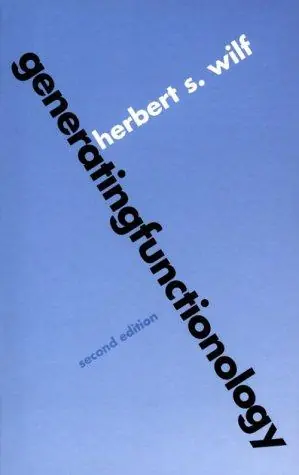
我非常推荐 Herbert Wilf 写的《Generatingfunctionology》https://www.math.upenn.edu/~wilf/gfologyLinked2.pdf
I really recommend Generatingfunctionology by Herbert Wilf https://www.math.upenn.edu/~wilf/gfologyLinked2.pdf
……挑战,而解答肯定能帮上忙。--- 就我个人而言,回头看那些我作为自学者啃完相当一部分(而且很喜欢)的书,比例还挺均匀:• 《Concrete Mathematics》和《Generatingfunctionology》都有完整解答。• Burton 的《Elementary Number Theory》有“提示”,以及部分习题的“答案”(也就是那些答案是数字而不是证明的题——这些对作者来说花不了多少功夫……
…challenge, and solutions can definitely help there. --- Personally, if I look back at books I went through a good fraction of as a self-learner (and loved), there's an even mix: • Concrete Mathematics and Generatingfunctionology have complete solutions. • Burton's Elementary Number Theory has “Hints”, and “Answers” to selected exercises (i.e. those where the answer was a number, not a proof — these are not much work for an author…
……形式代入方程,用初始条件求出 C_i 和 a_i。这跟解微分方程一模一样。另一条路是看形式幂级数,有一本好书是《Generatingfunctionology》。Knuth、Oren 和 Patashnik 的《Concrete Mathematics》把基础讲得很好,对有限差分演算讲得详细得多。
…form into the equation to find out the C_i and a_i using the initial conditions. It's exactly like solving a differential equation. Another path is to look at formal power series, and a good book is Generatingfunctionology. Knuth Oren and Patashnik's Concrete Mathematics covers the basics very well and goes into much more detail on finite difference calculus.
Lovasz 的《Combinatorial Problems and Exercises》。除了主题更聚焦的《Generatingfunctionology》(Wilf)和已经提到的《Enumerative Combinatorics》(Stanley)之外,关于更进阶的导论性组合数学书籍我了解得不多。
Combinatorial Problems and Exercises by Lovasz I don't know much in the way of more advanced expository combinatorics books, other than the more narrow Generatingfunctionology (Wilf) and the already mentioned Enumerative Combinatorics (Stanley).
对此没什么好补充的,只想说《Generatingfunctionology》是一本神书。虽然我还没读过,但同一领域的另一本书是《A=B》,也是 Wilf 合著的(https://www.math.upenn.edu/~wilf/AeqB.html)(另一位合著者是 Zeilberger,他的名字任何……
Nothing to add to this except to say that Generatingfunctionology is an awesome book. Although I haven't read it, another in the same space is A=B, also co-authored by Wilf (https://www.math.upenn.edu/~wilf/AeqB.html) (another co-author is Zeilberger, whose name anyone…
我觉得你思维里的错误在于,把无穷当成一个值或一个能到达的目的地。它是一个概念,行为方式和数字不一样。另外去读读《Generatingfunctionology》和《Concrete Mathematics》。
I think the mistake in your thinking is that infinity is a value or reachable destination. It's a concept and it behaves differently than a number. Also go read Generatingfunctionology and Concrete Mathematics