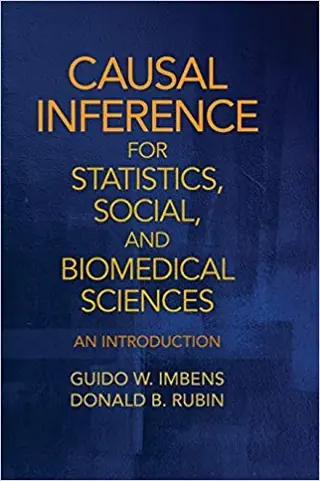
统计学、社会科学与生物医学的因果推断
Causal Inference for Statistics, Social, and Biomedical Sciences
Guido W. Imbens、Donald B. Rubin · 初版 2015 年
4人推荐
6位读者提及
6次提及
社会科学和生物医学领域的绝大多数问题本质上都是因果问题:如果个体或群体的部分环境发生改变,他们身上会发生什么?在这部开创性的著作中,两位世界知名专家系统介绍了研究此类问题的统计方法。本书从 potential outcomes 的概念切入,每一项潜在结果都对应着如果研究对象接受某种特定处理或干预方案时所产生的结果。在这种方法中,因果效应即为此类 potential outcomes 的比较。因果推断的根本问题在于,我们只能观察到
Hacker News 上怎么说
正在加载完整评论……
在计量经济学/经验社会科学领域:- 约书亚·安格里斯特(Joshua Angrist)和约恩-斯特芬·皮施克(Jorn Steffan Piscke)合著的《基本无害的计量经济学》(Mostly Harmless Econometrics)- 圭多·因本斯(Guido Imbens)和唐纳德·鲁宾(Donald Rubin)合著的《面向统计、社会和生物医学科学的因果推断》(Causal Inference for Statistics, Social, and Biomedical Sciences)- 安德鲁·格尔曼(Andrew Gelman)和珍妮弗·希尔(Jennifer Hill)合著的《使用回归与多层模型的数据分析》(Data Analysis using Regression and Multilevel Models)
In econometrics / empirical social science: - Mostly Harmless Econometrics by Joshua Angrist and Jorn Steffan Piscke - Causal Inference for Statistics, Social, and Biomedical Sciences by Guido Imbens and Donald Rubin - Data Analysis using Regression and Multilevel Models by Andrew Gelman and Jennifer Hill
因本斯和鲁宾的书《面向统计、社会和生物医学科学的因果推断:导论》(Causal Inference for Statistics, Social, and Biomedical Sciences: An Introduction)是潜在结果分析法(Potential Outcomes approach)的极佳参考书。网上还有不少鲁宾自己做的总结,在解释核心概念以及它们如何……方面做得非常棒。
Imbens and Rubin’s book “Causal Inference for Statistics, Social, and Biomedical Sciences: An Introduction” is an excellent reference for the Potential Outcomes approach. There are also several summaries online done by Rubin which do a great job of explaining the core concepts and how they…
……CS 那边的人往往喜欢用 Pearl 的 DAG 来做这类概念推演。我是在统计/经济学这边的,所以我用 Neyman-Rubin 模型。两者其实是等价的。推荐一下鲁宾和因本斯的《面向统计、社会和生物医学科学的因果推断》,这是一本很棒的教材,我们一般推荐给学习这些内容的研究生。我的一些学生跟我说,《因果推断混音带》(Causal Inference Mixtape)在那些不想死磕统计理论、想要更多……的人群里很受欢迎。
…in the CS side of things tend to use Pearl's DAGS for conceptualizing this stuff. I'm in the stats/econ side of things so I use Neyman-Rubin. They're equivalent. Allow me to suggest Rubin and Imbens - Causal Inference for Statistics, Social and Biomedical Sciences as a good textbook that we assign to graduate students learning this stuff. Some of my students tell me the "Causal Inference Mixtape" is popular among people who want less statistical theory and more…
……在把因果关系(尤其是结合了 data fusion 的!)置于现代系统(包括 ML)的核心地位这件事上,做到了清晰透彻且令人信服。如果对偏数学的内容更感兴趣,可以看看同一作者写的《因果关系》(Causality),或者因本斯和鲁宾写的《面向统计、社会和生物医学科学的因果推断》
…a clear and convincing job putting causality (esp. w/ data fusion!) at the heart of modern systems (including ML). For those on a more mathematical bend, check out "Causality" by the same author or "Causal Inference for Statistics, Social, and Biomedical Sciences" by Imbens and Rubin
我当时在找书评,结果看到了格尔曼推荐的《面向统计、社会和生物医学科学的因果推断》,还提到了这本书:http://www.hsph.harvard.edu/miguel-hernan/causal-inference-b... 有人能评价一下这几本吗?我读过 Pearl 早期的两本书,觉得关于因果关系的那本相当……
I was looking for a review, and found Gelman's recommendation of Causal Inference for Statistics, Social, and Biomedical Sciences and mention of this book: http://www.hsph.harvard.edu/miguel-hernan/causal-inference-b... Does anyone have a comment on those? I've read Pearl's two earlier books, and found the one on causality quite…
……两种截然不同的视角。但要让这套方法起效,你需要大量的数据:既要有大量的样本个体(比如人),又要有关于每个个体的海量信息。[0]《因果关系》(Causality),朱迪亚·珀尔(Judea Pearl)著 [1]《面向统计、社会和生物医学科学的因果推断:导论》(Causal Inference for Statistics, Social, and Biomedical Sciences: An Introduction),圭多·因本斯(Guido Imbens)与唐纳德·鲁宾(Donald Rubin)著
…two pretty different perspectives. But for this to work, you need a lot of data: both lots of units (e.g. people), and a lot of information about each individual unit. [0] Causality, Judea Pearl [1] Causal Inference for Statistics, Social, and Biomedical Sciences: An Introduction, Guido Imbens and Donald Rubin