不客气!- 首先是一些较新的成果,主要是综述。1. 以下是我所知道该领域最新的综述:《Inductive logic programming at 30》(Cropper 等人,2020)https://www.doc.ic.ac.uk/~shm/Papers/ilp30.pdf 2. 同一篇论文的略短版本,总结了新趋势:《Turning 30: New Ideas in Inductive Logic Programming》……
My pleasure! - First, some more recent work, mostly overviews. 1. The following is the most recent overview of the field I'm aware of: Inductive logic programming at 30 (Cropper et al, 2020) https://www.doc.ic.ac.uk/~shm/Papers/ilp30.pdf 2. And a slightly shorter version of the same paper that summarises new trends: Turning 30: New Ideas in Inductive Logic Programming…
……很高兴看到。Luc de Raedt、Kristian Kerstig 和 Stephen Muggleton 等人,以及归纳逻辑编程社区里的许多其他人,在结合关系型、基于逻辑的机器学习和统计机器学习方面做了更多工作。这个网站上有些不错的指引,指向 Lise Getoor 为该领域写的入门书:https://www.cs.umd.edu/srl-book/ ___________ * 索伦大人的。
…happy to see. There's more work on combining relational, logic-based machine learning and statistical machine learning by Luc de Raedt, Kristian Kerstig and Stephen Muggleton, among many others in the Inductive Logic Programming community. There's some good pointers on this website for Lise Getoor's introductory book to the field: https://www.cs.umd.edu/srl-book/ ___________ * Lord Sauron's.
……(确实是,这是个绝妙的想法)。>> 尚不清楚我们该如何扩展一个基于逻辑的系统来处理自然语言的杂乱无章。在 Muggleton 的《Latest Advances in Inductive Logic Programming》里有大量近期的内容,在此之前和之后也有别人做的大量工作。用逻辑来处理“杂乱”根本没毛病。就像我在别处指出的那样,你的电脑就是台逻辑机器,它处理起杂乱事务来不也挺溜的……
…(it is, it's a brilliant idea). >> it is not clear how we could extend a logic-based system to handle the messiness of natural language. There's a lot of recent stuff in Muggleton's Latest Advances in Inductive Logic Programming and a ton of work from others, before and after that. There's no problem in handling "messiness" with logic. Like I note elsewhere, your computer is a logic machine and it handles messiness just fine…
“ILP”(指归纳逻辑编程 Inductive Logic Programming,而不是整数线性规划 Integer Linear Programming)最初是在 1991 年 Stephen Muggleton 的一篇论文(《Inductive Logic Programming and Progol》)中命名的。那篇论文正式开创了这个领域,引发了极大的关注……
"ILP" (as in Inductive Logic Programming not Integer Linear Programming) was first named in 1991 in a paper by Stephen Muggleton ("Inductive Logic Programming and Progol). The paper properly launched the field and generated a great deal of excitement…
…Muggleton 2021) is a machine learning system that learns Prolog programs. Louise is a Meta-Interpretive Learning (MIL) system. MIL (Muggleton et al. 2014), (Muggleton et al. 2015), is a new setting for Inductive Logic Programming (ILP) (Muggleton, 1991). ILP is a form of weakly-supervised machine learning of logic programs from examples of program behaviour (meaning examples of the inputs and outputs of the programs to be learned).…
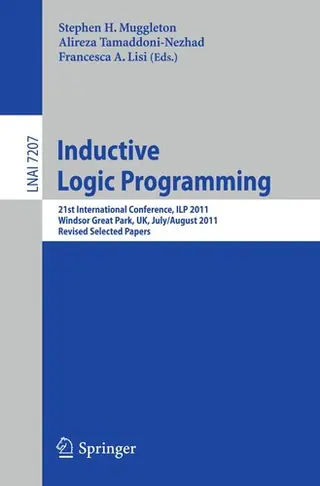
不客气!- 首先是一些较新的成果,主要是综述。1. 以下是我所知道该领域最新的综述:《Inductive logic programming at 30》(Cropper 等人,2020)https://www.doc.ic.ac.uk/~shm/Papers/ilp30.pdf 2. 同一篇论文的略短版本,总结了新趋势:《Turning 30: New Ideas in Inductive Logic Programming》……
My pleasure! - First, some more recent work, mostly overviews. 1. The following is the most recent overview of the field I'm aware of: Inductive logic programming at 30 (Cropper et al, 2020) https://www.doc.ic.ac.uk/~shm/Papers/ilp30.pdf 2. And a slightly shorter version of the same paper that summarises new trends: Turning 30: New Ideas in Inductive Logic Programming…
……很高兴看到。Luc de Raedt、Kristian Kerstig 和 Stephen Muggleton 等人,以及归纳逻辑编程社区里的许多其他人,在结合关系型、基于逻辑的机器学习和统计机器学习方面做了更多工作。这个网站上有些不错的指引,指向 Lise Getoor 为该领域写的入门书:https://www.cs.umd.edu/srl-book/ ___________ * 索伦大人的。
…happy to see. There's more work on combining relational, logic-based machine learning and statistical machine learning by Luc de Raedt, Kristian Kerstig and Stephen Muggleton, among many others in the Inductive Logic Programming community. There's some good pointers on this website for Lise Getoor's introductory book to the field: https://www.cs.umd.edu/srl-book/ ___________ * Lord Sauron's.
……(确实是,这是个绝妙的想法)。>> 尚不清楚我们该如何扩展一个基于逻辑的系统来处理自然语言的杂乱无章。在 Muggleton 的《Latest Advances in Inductive Logic Programming》里有大量近期的内容,在此之前和之后也有别人做的大量工作。用逻辑来处理“杂乱”根本没毛病。就像我在别处指出的那样,你的电脑就是台逻辑机器,它处理起杂乱事务来不也挺溜的……
…(it is, it's a brilliant idea). >> it is not clear how we could extend a logic-based system to handle the messiness of natural language. There's a lot of recent stuff in Muggleton's Latest Advances in Inductive Logic Programming and a ton of work from others, before and after that. There's no problem in handling "messiness" with logic. Like I note elsewhere, your computer is a logic machine and it handles messiness just fine…
“ILP”(指归纳逻辑编程 Inductive Logic Programming,而不是整数线性规划 Integer Linear Programming)最初是在 1991 年 Stephen Muggleton 的一篇论文(《Inductive Logic Programming and Progol》)中命名的。那篇论文正式开创了这个领域,引发了极大的关注……
"ILP" (as in Inductive Logic Programming not Integer Linear Programming) was first named in 1991 in a paper by Stephen Muggleton ("Inductive Logic Programming and Progol). The paper properly launched the field and generated a great deal of excitement…
……Muggleton 2021)是一个用于学习 Prolog 程序的机器学习系统。Louise 是一个元解释学习(Meta-Interpretive Learning, MIL)系统。MIL(Muggleton 等,2014;Muggleton 等,2015)是归纳逻辑编程(ILP)(Muggleton, 1991)的一个新分支设定。ILP 是一种弱监督机器学习形式,它通过程序行为的样例(即待学习程序的输入和输出样例)来学习逻辑程序。……
…Muggleton 2021) is a machine learning system that learns Prolog programs. Louise is a Meta-Interpretive Learning (MIL) system. MIL (Muggleton et al. 2014), (Muggleton et al. 2015), is a new setting for Inductive Logic Programming (ILP) (Muggleton, 1991). ILP is a form of weakly-supervised machine learning of logic programs from examples of program behaviour (meaning examples of the inputs and outputs of the programs to be learned).…