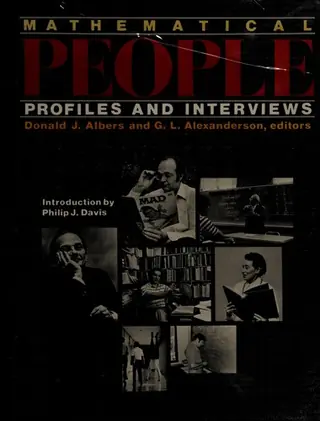
数学人物
Mathematical people
Donald J. Albers、Gerald L. Alexanderson · 初版 1985 年
1人推荐
4位读者提及
4次提及
对数学家、教师以及数学之友的访谈与人物小传,深入揭示了驱动数学创造过程的动机、哲学理念与非凡才华。
Hacker News 上怎么说
正在加载完整评论……
Mathematical people
Donald J. Albers、Gerald L. Alexanderson · 初版 1985 年
对数学家、教师以及数学之友的访谈与人物小传,深入揭示了驱动数学创造过程的动机、哲学理念与非凡才华。
正在加载完整评论……
我记得十几岁时在一本很棒的人物传记小书里读到过他 https://www.amazon.com/Mathematical-People-Interviews-Donald... 你可以在亚马逊的 Look Inside 预览功能里翻到目录,第 105 页写着罗纳德·L·葛立恒(Ronald L. Graham)。读起来非常有趣。
I recall reading about him as a teen in the great little bio book https://www.amazon.com/Mathematical-People-Interviews-Donald... There's a brief preview you can find in the Look Inside Amazon feature, navigating to the table of contents, which lists Ronald L. Graham on pg 105. Very entertaining read.
……以及其他形式的天赋确实具有家族遗传性。如果你读过科学家和数学家的传记(就像我现在正在读阿尔伯斯(Albers)编纂的数学家访谈文集《数学人群像》(Mathematical People)和《迷人的数学人群像》(Fascinating Mathematical People)),就会一次又一次地发现,一位伟大的数学家往往也有当数学家的亲戚,或者家里人在其他领域才华出众。想想巴赫家族、波尔加家族、……
…and other forms of talent certainly run in families. If you read bios of scientists and mathematicians (as I am doing now, actually, in reading the Albers compendiums of interviews with mathematicians, _Mathematical People_ and _Fascinating Mathematical People_), time and again you find that a great mathematician has mathematician relatives or family which were talented in other ways. Consider the Bachs, the Polgars, the…
……教学风格有点令人费解。他在 2008 年对《数学人群像:人物特写与访谈》(Mathematical People: Profiles and Interviews)的作者唐纳德·阿尔伯斯和杰拉尔德·亚历山大森说:“我的教学方针是尽可能多地教给学生,同时尽可能少地向他或她提要求。”但他也补充道,表面上宽容带来的效果却是,许多学生在他的课上比在其他任何课上都更用功。真希望能看到更多关于……的研究
…teaching was a little puzzling. “My policy is to teach the student as much as possible and to require from him or her as little as possible,” he told Donald Albers and Gerald Alexanderson, the authors of “Mathematical People: Profiles and Interviews” in 2008. But, he added, the impact of his apparent lenience was that many of his students worked harder in his course than in any other. Would love to see more studies around…
我灵光一闪想到的突破方法是:把研究课题当作课后作业题。关于这一点有个著名的故事,你在《数学人群像》(Mathematical People)这本书里能读到。乔治·丹齐格(George Dantzig)有一天上课迟到了,看到黑板上有两道题。他把它们做出来了,浑然不知教授把这两道题写在黑板上是作为尚未解决的研究难题的例子,而根本不是课后作业。……
The solution I hit upon which moved me forward was this: research problems are homework problems. There is a famous story about this, which you can read in the book Mathematical People. George Dantzig came late to class one day and saw two problems on the blackboard. He worked them, not knowing that his professor had posted them as examples of unsolved research problems, NOT homework.…