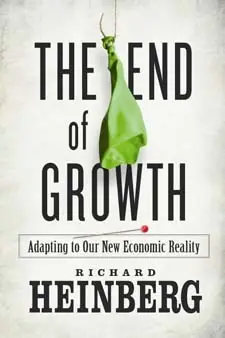
增长的终结
The end of growth
Richard Heinberg · 初版 2011 年
2人推荐
2位读者提及
5次提及
“经济学家坚称复苏已触手可及,然而失业率依然居高不下,房地产价值持续缩水,各国政府在创纪录的赤字重压下步履维艰。《The End of Growth》提出了一个令人震惊的诊断:人类已经迎来了经济史上的根本转折点。工业文明的扩张轨迹正与不可逾越的自然极限发生剧烈碰撞。Richard Heinberg 的最新里程碑之作直击当前金融危机的本质,剖析了危机为何以及如何爆发,以及我们必须采取何种行动以避免最灾难性的潜在后果。全书行文引人入胜、极富
Hacker News 上怎么说
正在加载完整评论……
……供给量还不足其中的百分之七。唯一有可能大幅提升这个百分比的,就是让能源需求的增速大幅放缓,比如降到每年百分之二。”我很喜欢理查德·海因伯格(Richard Heinberg)在《增长的极限》(The End of Growth,2011)里的这段话。尽管这些数字令人震惊,但我们确实在严重低估化石能源生产的体量。核能也存在类似的问题。我们真的处在指数级……
…supply less than seven percent of that. The only thing likely to boost that percentage much would be a dramatic reduction in growth of energy demand to, say, two percent annually." I like this from The End of Growth (2011) by Richard Heinberg. As much as the numbers are incredible we are really undermining the amount of energy produced by fossil sources. Similar problem with nuclear. Are we really on the exponential…
……推荐你看看这些,能进一步了解背后的实际动态。http://www.ourfiniteworld.com(她那个“新手入门”链接是个极好的科普)http://www.postcarbon.org/ 海因伯格出版过很多本书,《增长的终结》(The End of Growth)全面探讨了经济层面的影响,《蛇油》(Snake Oil)则专门针对石油和水力压裂法进行了剖析。
…recommend for more on what the actual dynamics are. http://www.ourfiniteworld.com (her "getting started" links are a great primer) http://www.postcarbon.org/ Heinberg's published numerous books, The End of Growth covers much of the economic impact, Snake Oil addresses oil and fracking specifically.
……在这个圈子里,从来不会有人因为判断失误受罚。没人会被取消在后续年会上宣读论文的资格,更不用提圈外人被邀请进来了。(引自罗伯特·海因伯格的《增长的终结》)。
…in this club, for having been wrong. No one is dis-invited from presenting papers at later annual meetings. And still less is anyone from the outside invited in. (Quoted in Robert Heinberg's The End of Growth).
……在 1943 年达到顶峰)、铜(1998 年)、铁矿石(1951 年)、镁(1966 年)、磷矿石(1980 年)、钾盐(1967 年)、稀土金属(1984 年)、锡(1945 年)、钛(1964 年)和锌(1969 年)”(引自理查德·海因伯格的《增长的终结》[1])。我利用 Wolfram+Alpha 的数据,更深入地探讨了解耦(decoupling)的概念,展示了 G8 国家加上中国、印度和巴西的能源消耗与 GDP 之间的关系,以及……
…peaked in 1943), copper (1998), iron ore (1951), magnesium (1966), phosphate rock (1980), potash (1967), rare earth metals (1984), tin (1945), titanium (1964), and zinc (1969)" (from Richard Heinberg's The End of Growth[1]) I've explored the concept of decoupling in greater length using Wolfram+Alpha data to show the relationship between energy use and GDP for the G8 nations plus China, India, and Brazil, as well as…