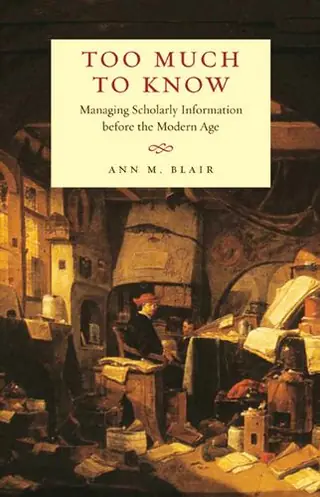
知之太多
Too much to know
Ann Blair · 初版 2010 年
1人推荐
5位读者提及
6次提及
技术进步带来的海量信息往往伴随着令人苦恼的“信息过载”感,但这种体验绝非现代所独有。事实上,Ann Blair 在这本引人入胜的书中指出,印刷术的发明以及随之而来的书籍激增,曾引发16和17世纪欧洲学者发出与我们极其相似的抱怨。作者考察了古代与中世纪欧洲、伊斯兰世界以及中国的信息管理方法,随后重点探讨了组织、编纂……
Hacker News 上怎么说
正在加载完整评论……
Too much to know
Ann Blair · 初版 2010 年
技术进步带来的海量信息往往伴随着令人苦恼的“信息过载”感,但这种体验绝非现代所独有。事实上,Ann Blair 在这本引人入胜的书中指出,印刷术的发明以及随之而来的书籍激增,曾引发16和17世纪欧洲学者发出与我们极其相似的抱怨。作者考察了古代与中世纪欧洲、伊斯兰世界以及中国的信息管理方法,随后重点探讨了组织、编纂……
正在加载完整评论……
……以上就是我目前收集的书单。我建议先看这几本:* Roland Allen 的《The Notebook: A History of Thinking on Paper》(这是一本快节奏的微观史,提炼了所有重点。)* Ann M. Blair 的《Too Much To Know: Managing Scholarly Information Before the Modern Age》(她在这方面非常有造诣。)* 《Forgetting Machines: Knowledge Management Evolution in Early Modern Europe》,作者是……
…That's my list of sources from those that I have so far. I would say start with: * The Notebook: A History of Thinking on Paper by Roland Allen (This is a fast micro history that hits the highlights.) * Too Much To Know: Managing Scholarly Information Before the Modern Age by Ann M. Blair (She is a scholar that has a lot on the subject.) * Forgetting Machines: Knowledge Management Evolution in Early Modern Europe by…
老问题了。Ann Blair 的书《Too Much to Know》讲的就是近代早期欧洲的知识分子如何应对信息过载:https://yalebooks.yale.edu/book/9780300165395/too-much-know
Old problem. The book "Too Much to Know" by Ann Blair is about how intellectuals dealt with information overload in early modern Europe: https://yalebooks.yale.edu/book/9780300165395/too-much-know
Richard Yeo(2014)《Notebooks, English Virtuosi, and Early Modern Science》;Ann Blair(2010)《Too Much to Know: Managing Scholarly Information Before the Modern Age》
Richard Yeo (2014) Notebooks, English Virtuosi, and Early Modern Science Ann Blair (2010) Too Much to Know: Managing Scholarly Information Before the Modern Age
……政府统计的贫困线,而是从面向未来的取向,或者说时间偏好的角度来看。我以前从没听过有人把这个观点阐述得这么清晰。我还没深入研究过这个论点,没法断言谁对谁错,也提不出什么深刻的批评,但它确实吸引了我的注意,我已经把它加进待读书单(TODO)了。
…government statistical poverty levels, but in terms of orientation toward the future, or time preference. I can't say I ever heard such an idea so clearly stated before. I still haven't dug into the argument too much to know one way or another or be able to offer much in way of a critique, but it's caught my eye and attention enough to make it a reading TODO.
我常说编程这门手艺,关键在于知道哪些兔子洞该钻,哪些该直接跨过去。需要知道的东西太多了,不可能每个坑都深度优先(depth-first)钻到底。还是广度优先(breadth first)吧,接受自己知识上的盲区——大家都有盲区。如果某件事从没出现过,也从没引发过需要深究的问题,而且项目……
I like to say programming is about knowing which rabbit holes to plunge down and which to step over. There's too much to know to go depth-first down every rabbit hole. Go breadth first and accept gaps in your knowledge - everyone has them. If something never comes up and never causes an issue you need to look into, and the project…
……这个话题牵涉很广,这里列一下我已经读过或打算读的书单:* Roland Allen 的《The Notebook: A History of Thinking on Paper》* Ursula K. Le Guin 的《The Carrier Bag Theory of Fiction》* Ann M. Blair 的《Too Much To Know: Managing Scholarly Information Before the Modern Age》* Niklas Luhmann 的《Communicating with Slip Boxes: An Empirical Account》* 《Akin's Laws of Spacecraft Design》* 《Writing the Laboratory》……
…many facets to this topic here's a list that I have read or am going to read. * The Notebook: A History of Thinking on Paper by Roland Allen * The Carrier Bag Theory of Fiction by Ursula K. Le Guin * Too Much To Know: Managing Scholarly Information Before the Modern Age by Ann M. Blair * Communicating with Slip Boxes: An Empirical Account by Niklas Luhmann * Akin's Laws of Spacecraft Design * Writing the Laboratory…