…Capitalist society that has orders of magnitude more abundance, can get out of said paralysis. Not. At. All. Edit: I wanna be really clear. Aristotle has some very useful things to say, particularly in De Anima, which, IMO, is the sole philosophical definition of a soul that is capable of being set in alignment with the concept of evolution, but the Ethics is a really big hype job that has lots of important…
…animals, sure, but there's a difference between the two degrees of attribution. Attributing consciousness is far more conservative than attributing human qualities in an equivocal way. Take Aristotle's De Anima, for example, in which he analyzes the varieties of life according to the kind of "soul" each possesses, and such that each higher soul entails the powers of all the lower souls. The three kinds he identifies,…
…are particularly “special.” Instead, there are spirits in everything, [...] "Empedocles [says that the soul] is composed of all the elements and that each of them actually is a soul [...]" (Aristotle, De Anima, 404b11) "All things are full of gods." (Thales. From Aristotle, De Anima, 411a) "Now consider all the stars and the moon and the years and the months and all the seasons: what can we do except repeat…
…emotions, desires or consciousness. In the context of intellectual history, this Cartesian view is rather recent. Aristotle, for example, describes plants, animals and human beings quite differently in De Anima. In his analysis, human beings entail all faculties that are essentially proper to animals, and non-human animals entail all faculties that are essentially proper to plants; the entailment is transitive…
…the definition/actual taking place of the Good lies in some other plane, we can't participate in it so no one is or can be good), but the idea is the same even when he's talking about what a soul is in De Anima. Aristotle doesn't believe in 'souls' in the way we think of them as religio-spiritual entities that exceed the capacity of the body; a 'soul' for Aristotle is the body but in a way that radically challenges…
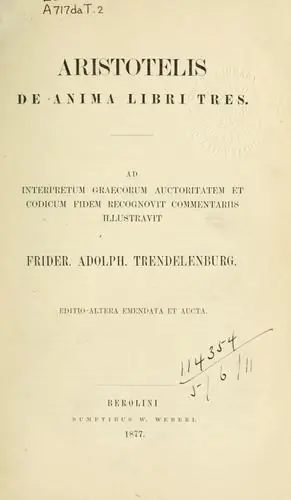
亚里士多德的《物理学》、《形而上学》和《论灵魂》(De Anima)。
Aristotle's Physics, Metaphysics, and De Anima.
……物质丰富程度高出几个数量级的资本主义社会,就能摆脱这种瘫痪状态。绝。对。不。能。修改补充:我想说得更明确一点。亚里士多德讲过一些非常有用的东西,尤其是在《论灵魂》里,依我看,那是唯一能与进化论概念相契合的灵魂哲学定义,但他的《伦理学》实在被吹过头了,里面很多重要的……
…Capitalist society that has orders of magnitude more abundance, can get out of said paralysis. Not. At. All. Edit: I wanna be really clear. Aristotle has some very useful things to say, particularly in De Anima, which, IMO, is the sole philosophical definition of a soul that is capable of being set in alignment with the concept of evolution, but the Ethics is a really big hype job that has lots of important…
……动物当然可以,但归因的这两个程度之间存在差异。归因意识远比含糊不清地归因人类特质要保守得多。以亚里士多德的《论灵魂》为例,他在书中根据各类生命所拥有的不同“灵魂”来分析生命的多样性,并且每种更高级的灵魂都涵盖了所有较低级灵魂的能力。他区分的三种灵魂,……
…animals, sure, but there's a difference between the two degrees of attribution. Attributing consciousness is far more conservative than attributing human qualities in an equivocal way. Take Aristotle's De Anima, for example, in which he analyzes the varieties of life according to the kind of "soul" each possesses, and such that each higher soul entails the powers of all the lower souls. The three kinds he identifies,…
……特别“特殊”。相反,万物皆有灵,[…]“恩培多克勒[说灵魂]是由所有元素构成的,其中每一种元素实际上都是一个灵魂[…]”(亚里士多德,《论灵魂》,404b11)“万物皆充满神灵。”(泰勒斯,引自亚里士多德《论灵魂》,411a)“现在想想所有的星辰、月亮、年、月以及所有季节:除了重复……我们还能做什么
…are particularly “special.” Instead, there are spirits in everything, [...] "Empedocles [says that the soul] is composed of all the elements and that each of them actually is a soul [...]" (Aristotle, De Anima, 404b11) "All things are full of gods." (Thales. From Aristotle, De Anima, 411a) "Now consider all the stars and the moon and the years and the months and all the seasons: what can we do except repeat…
……情感、欲望或意识。从思想史的脉络来看,这种笛卡尔式的观点其实相当晚近。例如亚里士多德在《论灵魂》中对植物、动物和人类的描述就大相径庭。在他的分析中,人类涵盖了动物本质上具有的所有机能,而非人动物则涵盖了植物本质上具有的所有机能;这种包含关系是具有传递性的……
…emotions, desires or consciousness. In the context of intellectual history, this Cartesian view is rather recent. Aristotle, for example, describes plants, animals and human beings quite differently in De Anima. In his analysis, human beings entail all faculties that are essentially proper to animals, and non-human animals entail all faculties that are essentially proper to plants; the entailment is transitive…
……“善”的定义/现实存在是处于另一个维度的,我们无法参与其中,所以没有人是善的,也不可能成为善的),但他在《论灵魂》中探讨什么是灵魂时,思路也是完全一样的。亚里士多德所相信的“灵魂”,并不是我们通常认为的那种超越肉体能力的宗教精神实体;对亚里士多德来说,灵魂就是肉体,但这种方式彻底颠覆了……
…the definition/actual taking place of the Good lies in some other plane, we can't participate in it so no one is or can be good), but the idea is the same even when he's talking about what a soul is in De Anima. Aristotle doesn't believe in 'souls' in the way we think of them as religio-spiritual entities that exceed the capacity of the body; a 'soul' for Aristotle is the body but in a way that radically challenges…