…their existing methods. Even advanced undergraduate math students who read it aren’t going to fully understand the book IMO; I would recommend Pólya’s other books (Mathematics and Plausible Reasoning, Mathematical Discovery), or maybe start with a gentler book like Mason, Burton, & Stacey, Mathematical Thinking.
……依我之见,第一步是要去思考“解题”这件事情本身。例如参考:Mason、Burton 和 Stacey 的《Thinking Mathematically》;Pólya 的《How to Solve It》(怎样解题)、《Mathematics and Plausible Reasoning》(上下卷)、《Mathematical Discovery》(上下卷);Schoenfeld 的《Mathematical Problem Solving》;Larson 的《Problem-Solving Through Problems》
…a first step in my opinion is to think about problem solving per se. E.g. see: Mason, Burton, & Stacey, Thinking Mathematically Pólya, How to Solve It; Mathematics and Plausible Reasoning (2 vols); Mathematical Discovery (2 vols) Schoenfeld, Mathematical Problem Solving Larson, Problem-Solving Through Problems
……词典风格,由针对特定解题主题的短章节组成,如果没有指导的话,初学者会有些难以领会。我建议不妨看看 Polya 的另外两部书(各两卷):《Mathematical Discovery》和《Mathematics and Plausible Reasoning》。
…dictionary–style with short sections on particular named problem solving topics, and is somewhat hard to interpret for novices without guidance, let me recommend Polya’s other two books (each 2 volumes), Mathematical Discovery and Mathematics and Plausible Reasoning.
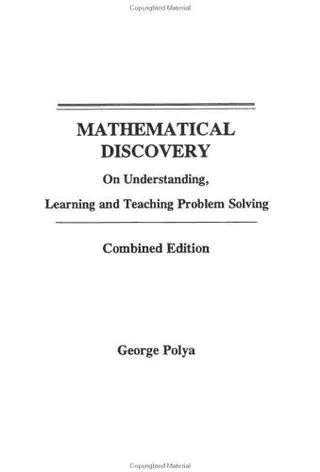
……关于帕斯卡三角的导论,以及 Polya 提出的一些极具传奇色彩的解题洞见(凭记忆意译一下:“一旦你发现了规律,你就触及到了关键”),绝对是这本书的亮点。George Polya 的《Mathematical Discovery: On Understanding, Learning and Teaching Problem Solving》。基于前一本书以及我对阅读《How to Solve it》的美好回忆,我从图书馆借了这本。同样,我不能保证……
…introduction with Pascal's triangle and some of Polya' legendary problem solving insights (paraphrased from my memory: "you are on to something once you find a pattern") are definitely highlights in this book. Mathematical Discovery: On Understanding, Learning and Teaching Problem Solving by George Polya. Based on the previous book and my fond memories of reading "How to Solve it", I got this one from the library. Again I can't attest…
……在 1956 年匈牙利革命前夕的一个学生组织。> ……他于 1961 年在剑桥大学获得哲学博士学位;他的博士论文题目是《数学发现逻辑论文集》(Essays in the Logic of Mathematical Discovery),博士生导师是 R. B. Braithwaite。在他去世后出版的著作《证明与反驳:数学发现的逻辑》(Proofs and Refutations: The Logic of Mathematical Discovery)正是基于这项工作。
…student group in the lead-up to the 1956 Hungarian Revolution. > ... He received a PhD in philosophy in 1961 from the University of Cambridge; his doctoral thesis was entitled Essays in the Logic of Mathematical Discovery, and his doctoral advisor was R. B. Braithwaite. The book Proofs and Refutations: The Logic of Mathematical Discovery, published after his death, is based on this work.
……现有的方法。在我看来,就算是高年级的数学系本科生,读了也未必能完全理解这本书;我会推荐 Pólya 的其他著作(《Mathematics and Plausible Reasoning》(数学与猜想)、《Mathematical Discovery》(数学的发现)),或者也可以先从一本更浅显的书入门,比如 Mason、Burton 和 Stacey 写的《Thinking Mathematically》(数学思维)。
…their existing methods. Even advanced undergraduate math students who read it aren’t going to fully understand the book IMO; I would recommend Pólya’s other books (Mathematics and Plausible Reasoning, Mathematical Discovery), or maybe start with a gentler book like Mason, Burton, & Stacey, Mathematical Thinking.
……依我之见,第一步是要去思考“解题”这件事情本身。例如参考:Mason、Burton 和 Stacey 的《Thinking Mathematically》;Pólya 的《How to Solve It》(怎样解题)、《Mathematics and Plausible Reasoning》(上下卷)、《Mathematical Discovery》(上下卷);Schoenfeld 的《Mathematical Problem Solving》;Larson 的《Problem-Solving Through Problems》
…a first step in my opinion is to think about problem solving per se. E.g. see: Mason, Burton, & Stacey, Thinking Mathematically Pólya, How to Solve It; Mathematics and Plausible Reasoning (2 vols); Mathematical Discovery (2 vols) Schoenfeld, Mathematical Problem Solving Larson, Problem-Solving Through Problems
……词典风格,由针对特定解题主题的短章节组成,如果没有指导的话,初学者会有些难以领会。我建议不妨看看 Polya 的另外两部书(各两卷):《Mathematical Discovery》和《Mathematics and Plausible Reasoning》。
…dictionary–style with short sections on particular named problem solving topics, and is somewhat hard to interpret for novices without guidance, let me recommend Polya’s other two books (each 2 volumes), Mathematical Discovery and Mathematics and Plausible Reasoning.
去读读 Imre Lakatos 写的《Proofs and Refutations, The Logic of Mathematical Discovery》(证明与反驳:数学发现的逻辑)。那本书可能会给你的问题提供一个很好的答案。
Read 'Proofs and Refutations, The Logic of Mathematical Discovery' by Imre Lakatos. That may provide a good answer to your question.
……关于帕斯卡三角的导论,以及 Polya 提出的一些极具传奇色彩的解题洞见(凭记忆意译一下:“一旦你发现了规律,你就触及到了关键”),绝对是这本书的亮点。George Polya 的《Mathematical Discovery: On Understanding, Learning and Teaching Problem Solving》。基于前一本书以及我对阅读《How to Solve it》的美好回忆,我从图书馆借了这本。同样,我不能保证……
…introduction with Pascal's triangle and some of Polya' legendary problem solving insights (paraphrased from my memory: "you are on to something once you find a pattern") are definitely highlights in this book. Mathematical Discovery: On Understanding, Learning and Teaching Problem Solving by George Polya. Based on the previous book and my fond memories of reading "How to Solve it", I got this one from the library. Again I can't attest…
……在 1956 年匈牙利革命前夕的一个学生组织。> ……他于 1961 年在剑桥大学获得哲学博士学位;他的博士论文题目是《数学发现逻辑论文集》(Essays in the Logic of Mathematical Discovery),博士生导师是 R. B. Braithwaite。在他去世后出版的著作《证明与反驳:数学发现的逻辑》(Proofs and Refutations: The Logic of Mathematical Discovery)正是基于这项工作。
…student group in the lead-up to the 1956 Hungarian Revolution. > ... He received a PhD in philosophy in 1961 from the University of Cambridge; his doctoral thesis was entitled Essays in the Logic of Mathematical Discovery, and his doctoral advisor was R. B. Braithwaite. The book Proofs and Refutations: The Logic of Mathematical Discovery, published after his death, is based on this work.